
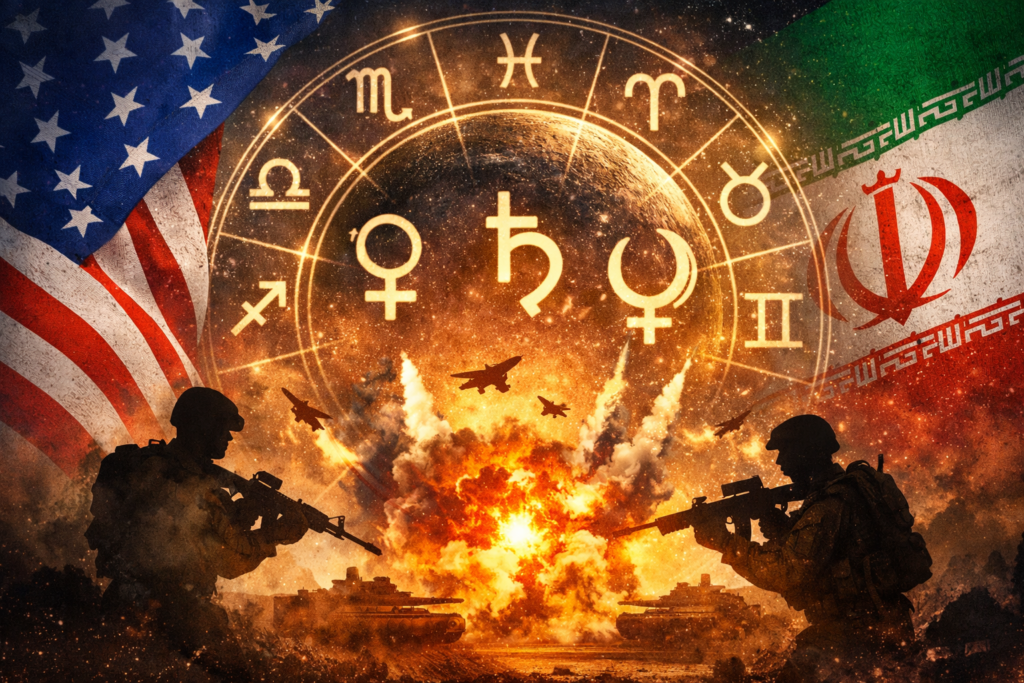
The tension between the United States and Iran never really disappears. It only changes shape.
One month it’s diplomatic maneuvering, the next it’s military posturing, sanctions, or shadow conflicts that ripple through headlines and global markets. As uncertainty builds again, many people—quietly and thoughtfully—are turning to astrology not for certainty, but for context.
Astrology doesn’t tell us what will happen.
It helps us understand why certain moments feel heavier than others.
And right now, the sky is undeniably heavy.
Why Astrology Resurfaces During Global Crises
When geopolitics becomes unpredictable, humans look for patterns. We always have.
Astrology often resurfaces during periods of global anxiety because it offers something rare: a long view. While political analysis focuses on strategies and power, astrology looks at cycles—recurring themes of pressure, escalation, restraint, and release.
During wars, revolutions, and diplomatic stand-offs, astrologers don’t search for headlines written in the stars. They observe timing, tension, and psychological climates. It’s less about fate and more about weather conditions.
You wouldn’t plan a sea voyage without checking the forecast.
Astrology serves a similar role for history.
USA–Iran Relations Through Planetary Cycles
The modern USA–Iran relationship has never been neutral. It has swung between cooperation, resentment, rupture, and strategic containment—often coinciding with intense planetary alignments.
- 1953: The U.S.-backed coup in Iran occurred during a period of strong Pluto activity—classic for covert power shifts and regime control.
- 1979: The Iranian Revolution and hostage crisis unfolded under volatile Uranus transits, a planet linked to rebellion and sudden breaks.
- 2003–2015: Sanctions, nuclear negotiations, and proxy conflicts coincided with long Saturn–Pluto cycles—periods associated with control, fear, and restructuring power.
- 2020: The killing of General Qasem Soleimani occurred during a rare Saturn–Pluto conjunction, a configuration astrologers associate with moments where pressure snaps into action.
Astrology doesn’t cause events.
But it often mirrors the type of events that emerge.
The National Charts: What Drives the USA and Iran
Every country has a “birth chart” used by astrologers to study its core identity.
The United States chart is driven by themes of independence, assertion, and ideological leadership. Its planetary emphasis reflects a nation that reacts strongly when it perceives threats to autonomy or global influence.
Iran’s chart, by contrast, carries deep themes of sovereignty, historical memory, and resistance to external control. Power struggles here are rarely just strategic—they’re symbolic and emotional.
This is why USA–Iran tensions escalate so quickly.
Both charts are sensitive to dominance, pride, and perceived humiliation.
Negotiations often stall not because solutions don’t exist—but because timing and trust are misaligned.
Current Planetary Transits: Pressure Without Release
This year’s astrological landscape explains why the situation feels unresolved rather than explosive.
Saturn’s Role: Delay and Consequence
Saturn is emphasizing restraint, caution, and consequences. This planet rarely supports impulsive war declarations. Instead, it favors prolonged pressure—sanctions, slow negotiations, and strategic waiting.
Mars: Controlled Aggression
Mars, the planet associated with conflict, is active but constrained by heavier planets. This suggests posturing without full escalation. Think warnings, military exercises, proxy actions—not open war.
Eclipses: Hidden Turning Points
This year’s eclipses activate sensitive degrees linked to diplomacy and resources. Eclipses often bring behind-the-scenes developments that don’t immediately surface publicly. Something shifts—but quietly.
Retrogrades: Rewriting the Past
Several planetary retrogrades indicate revisiting old agreements, unresolved grievances, and stalled talks. Retrogrades are notorious for delays and reversals rather than decisive action.
In astrological terms, this is not a “rush to war” sky.
It’s a pressure cooker without a clear release valve.
War or Restraint? What Astrology Suggests Right Now
Astrology rarely speaks in absolutes, especially when it comes to geopolitics.
What it does suggest right now is a period of heightened tension combined with hesitation. The planets reflect:
- Strong internal pressure within both nations
- Fear of unintended escalation
- A preference for indirect confrontation over direct conflict
- Diplomatic efforts happening out of public view
This aligns with what we see politically: firm rhetoric paired with careful avoidance of red lines.
If conflict were imminent, astrologers would expect faster, more aggressive Mars alignments supported by Uranus or Pluto. Instead, the current transits suggest caution born of consequence.
History pauses here—not because peace is guaranteed, but because escalation carries too high a cost.
How a USA–Iran Conflict Would Ripple Globally (Astrological Lens)
Astrology doesn’t isolate nations. It looks at networks.
The USA–Iran axis is deeply tied to global energy flows, regional alliances, and collective fear cycles. When tension spikes here, markets react before missiles ever move.
Astrologically, current transits highlight:
- Energy volatility, especially oil and gas markets
- Alliance testing, particularly among regional powers
- Psychological unease, where fear spreads faster than facts
Even without war, the anticipation of conflict can destabilize economies and political confidence. Astrology reflects this as collective anxiety rather than immediate catastrophe.
The world feels on edge because the sky mirrors that edge.
Astrology, Free Will, and an Unwritten Outcome
Astrology is not destiny.
It is context.
Planetary transits describe the quality of time, not its outcome. Leaders still choose. Diplomats still negotiate. Accidents still happen—or don’t.
The current astrological climate suggests a moment of reckoning without resolution. Pressure demands attention, but restraint still has power.
History has shown that some of the most dangerous periods are the ones where war almost happens.
Astrology reminds us of something crucial:
Cycles pass. Tensions peak and recede. Even the most intense skies eventually shift.
Whether the USA and Iran move toward confrontation or cautious recalibration remains open. The stars don’t command—but they do caution.
And right now, caution matters.
In uncertain times, astrology doesn’t offer answers.
It offers perspective.
Если вы ищете лучший вариант, чтобы цены айфонов, то следует выбрать надежный интернет-магазин или официальный сайт производителя для получения оригинальной продукции и дополнительных услуг, таких как гарантия и поддержка.
айфон может стать вашим новым компаньоном . Айфоны известны своей высокой производительностью и долговечностью . айфон может стать вашим верным помощником в любых ситуациях .
айфоны созданы для тех, кто хочет иметь лучшее. айфон станет вашим постоянным спутником. айфоны регулярно обновляются, чтобы соответствовать последним тенденциям в технологиях.
**Раздел 2: Преимущества айфонов**
айфоны славятся своей высокой скоростью работы и большой памятью . айфон обеспечивает вам безопасную и защищенную связь. айфон имеет функцию Siri, которая может помочь вам с различными задачами.
Айфоны разработаны для того, чтобы быть универсальными и функциональными . айфон обеспечит вам высокое качество связи и интернета. Айфоны выпускаются в различных размерах и форматах, что позволяет вам выбрать тот, который лучше всего подходит вашим потребностям .
**Раздел 3: Выбор айфона**
Если вы решили купить айфон, вам следует рассмотреть несколько факторов . айфоны имеют различные функции и опции, которые могут удовлетворить ваши потребности . айфон обеспечит вам доступ к широкому спектру приложений и сервисов.
айфоны имеют большое количество функций и опций, которые могут удовлетворить ваши потребности. Купив айфон, вы сможете наслаждаться его функциями и возможностями . айфоны имеют отличную систему камер, которая позволяет делать высококачественные фотографии.
**Раздел 4: Заключение**
Если вы ищете новый смартфон, айфон может быть хорошим выбором . айфоны славятся своей простотой использования и стильным дизайном . Купить айфон может быть хорошей инвестицией в ваше будущее .
айфоны предназначены для пользователей, которые ценят качество и стиль . айфон откроет для вас новые горизонты в мире технологий . Айфоны имеют ряд преимуществ, которые сделали их популярными среди пользователей .
Узнайте больше о песок для песочницы в мешках купить — оптимальный выбор для ваших строительных проектов!
Песок с доставкой — это удобный способ обеспечить строительный или ландшафтный проект без лишних хлопот. Благодаря такой услуги, процесс выполнения работ становится значительно проще.
Время доставки зависит от объема заказанных материалов и расстояния до объекта. Также доступны дополнительные услуги, такие как укладка и просеивание песка.
Обратиться за песком с доставкой можно через телефон или онлайн-форму. Перед заключением договора нужно ознакомиться с условиями и ценами.
Это обеспечивает высокий уровень комфорта и оперативности в выполнении задач. Покупатели остаются довольны тем, как быстро и качественно осуществляются их заказы.
Если вы сейчас разбираетесь с SEO, можете посмотреть SEO-блог: продвижение в Google — там есть разборов по выбору ниши, контенту и продвижению.
безопасный вывод из запоя алматы поможет быстро и безопасно организовать качественный вывод из запоя в Алматы.
Эффективные программы реабилитации предлагают структурированные планы возвращения к нормальной жизни после вывода из запоя.
Надёжно и недорого организуем вывоз строительного мусора в москве недорого из квартиры, быстро вывозим мусор с погрузкой и вывозим по доступным ценам.
Соблюдение правил уменьшает риск штрафных санкций и экологических последствий.
Чтобы купить светодиодные оборудование, посетите купить светодиодные оборудование.
Стоит изучать отзывы покупателей и требовать подтверждающие документы и сертификаты.
Щебень гравийный можно купить быстро и надежно через купить щебень гравийный.
Определение подходящей фракции щебня существенно влияет на долговечность объектов.
Надёжно и недорого организуем заказать машину для вывоза строительного мусора, быстро вывозим мусор с погрузкой и вывозим по доступным ценам.
Многие коммунальные предприятия вкладывают средства в сортировочные линии и компостирование органики.
Чтобы купить светодиодные оборудование, посетите светодиодное оборудование.
Для коридоров и общих зон подходят бюджетные и долговечные светильники.
Щебень гравийный можно купить быстро и надежно через щебень гравийный цена за куб с доставкой.
Гравийный щебень применяют и в декоративных решениях для оформления садовых участков.
В Москве существует множество автосервисов, специализирующихся на Тойота. Специалисты готовы осуществлять ремонт и обслуживание ваших автомобилей.
Если вам нужен качественный и надежный автосервис Тойота в Москве, мы предлагаем широкий спектр услуг для вашего автомобиля.
Для Тойота необходим высокий уровень квалификации. Все работники имеют соответствующую квалификацию и опыт.
В автосервисе установлено современное оборудование. Наличие современного оборудования существенно упрощает процесс диагностики.
Обращаясь в автосервис Тойота, вы можете рассчитывать на высокое качество услуг. Наши клиенты всегда остаются довольны результатом работ.
строительство каркасных домов в спб — отличное решение для быстрого и экономичного возведения уютного загородного жилья.
Это объясняется сочетанием скорости строительства и экономичности.
Также такие дома проще подвергаются модернизации и реконструкции при желании владельца.
Правильно организованная вентиляция обеспечивает комфортный микроклимат и предотвращает сырость.
Но конечная цена определяется отделочными решениями и уровнем инженерного оснащения.
Нужен быстрый и недорогой вывоз мусора из квартиры москва, чтобы быстро освободить квартиру после ремонта.
Правильное планирование маршрутов и частоты вывоза позволяет экономно расходовать ресурсы и поддерживать чистоту населённых пунктов.
Ищете заказать машину с водителем — позвоните нам, и мы подберём идеальный автомобиль с профессиональным водителем для комфортных поездок по Новосибирску.
В заключение, аренда авто с водителем остаётся практичным и выгодным решением для многих ситуаций в городе.
дом каркасный под ключ — отличное решение для быстрого и экономичного возведения уютного загородного жилья.
Именно от них зависят выбор конструкции и необходимая степень утепления.
К тому же каркасники удобнее в перепланировке и последующих доработках.
Окна и двери также влияют на теплопотери и комфорт проживания.
По стоимости возведения каркасный дом зачастую оказывается дешевле кирпичных и блочных строений.
Ищете аренда авто с водителем в новосибирске — позвоните нам, и мы подберём идеальный автомобиль с профессиональным водителем для комфортных поездок по Новосибирску.
В заключение, аренда авто с водителем остаётся практичным и выгодным решением для многих ситуаций в городе.
Нужен быстрый и недорогой вывоз строительного мусора с погрузкой, чтобы быстро освободить квартиру после ремонта.
Новые технологии в сфере обращения с отходами позволяют оптимизировать маршруты и сократить издержки на вывоз мусора.